A merger can be a complete legal success… and still fail on the human level. It plays out in how two cultures learn to recognise each other, understand each other, and work together. When that human work is properly supported, the merger becomes a new shared project — not just a strategic transaction.
"On paper, the merger is done. But the teams don't yet feel like they're part of the same company."
"I can feel there's still a lot of caution between the teams."
"Managers want to reassure their teams, but they don't have all the answers yet."
"We want to build something shared, without flattening what each side brings."
This is precisely where we step in.
Clarifying their posture and role in this sensitive phase.
Surfacing perceptions, fears and expectations.
Identifying what each culture brings to the shared future.
Bringing the new organisation's practices and reference points to the surface.
We're particularly useful when:
Yes, and often faster than you'd think. Poorly managed human integration slows decisions, weakens cooperation and drives out key people — with direct consequences for clients and the deal's expected performance. Conversely, when the human dimension is addressed from the start, teams understand the project faster and new working relationships form without delay. The challenge isn't to "manage the human factor" alongside the project, but to create the human conditions that let it succeed. That's Archipel Connect's role: securing people and ways of working at the same pace as the Business and the Operating Model.
Not systematically. But as soon as a deal involves a major change in organisation, management or ways of working, an outside perspective strongly de-risks the integration: it helps identify people and groups at risk, surface what's left unsaid, and spot tensions before they become blockages. At Archipel Connect, we intervene in a targeted way, at the pace of the integration — the goal isn't to "transform the culture" for its own sake, but to secure the human conditions that let the strategic project deliver its results: retaining key talent, smoothing cooperation, clarifying roles.
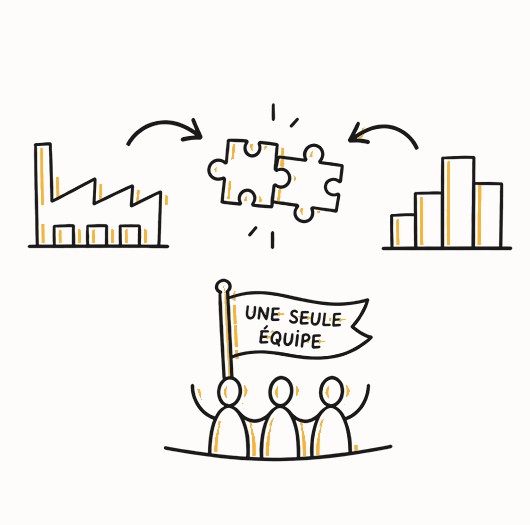
A complete integration plan is built on three dimensions run in parallel: the Business (clients, revenue, margin, synergies), the Operating Model (processes, tools, governance, IT, finance) and People (management, talent, cooperation, communication). Focusing only on the financial side is one of the most common mistakes. Yet People is what determines the organisation's ability to make the other two actually work: a new organisation chart can look perfect on paper, but if managers don't know how to work together or key people leave, the plan loses its effectiveness. This is the dimension Archipel Connect works on, so that people become a lever for value creation rather than a variable to adjust.
Several signals should raise a flag: teams still talk in terms of "us" and "them", decisions require more and more arbitration, managers don't know what to tell their teams, tensions play out in the corridors rather than in decision-making spaces, or key talent starts questioning their place. Taken individually, these signals are normal early in an integration — it's their persistence or accumulation that should raise concern. Outside support can then quickly surface what's really going on, before it starts weighing on results.
The most reliable signal isn't the absence of tension, but the teams' ability to work together despite their differences: speaking to each other directly, deciding, resolving a disagreement without every issue becoming an arbitration between the two former entities. The org chart can be merged in a few weeks; ways of working take longer. At Archipel Connect, we assess from the very first weeks what's really happening in working relationships — perceptions, expectations, irritants, quality of management — to distinguish the normal difficulties of an integration from the signals that call for action.
Buy-in can't be decreed, and it isn't built through communication alone: it first depends on leaders' and managers' ability to give meaning, address concerns and concretely embody the project. So we start by supporting them — what to say, what to decide, what posture to take in the face of resistance — before gradually creating spaces where teams contribute to the shared project and express what each side brings to it. The goal isn't to erase the differences, but to turn two ways of working into a real capacity to work together.
It depends on the scale of the deal, the level of transformation expected, and the human challenges identified. Some engagements focus on a few key moments — assessment, preparing leaders and managers, securing the launch. Others run over the longer term to support a new organisation and evolve managerial practices. At Archipel Connect, we adapt the duration to your situation: the goal is to intervene where it creates the most value, not to keep a programme running longer than necessary.
As early as possible is ideal: from the announcement, we help leaders anticipate the human challenges and prepare managers for their role in the integration. But it's never too late — we also step in several months after a merger, when teams are still siloed, managers are struggling to find their footing, or the expected benefits of the deal are slow to materialise. The earlier the intervention, the more it prevents difficulties; but support can also unblock an integration that hasn't gone the way it was meant to.
We can support the leaders, managers and teams of both entities. In an acquisition, the point isn't to put the two companies on equal footing: the acquirer carries a strategic project and must be able to exercise its role as leader. Our role is to prevent the integration from becoming a matter of mechanically imposing one model on the other, by helping teams identify what should be preserved, what should evolve, and what should be built together — so as to keep the strengths of the acquired company alive within a coherent shared organisation.
No. Involvement should be gradual and adapted to the context. We often start with leaders and managers, who first need to be aligned on the project, the decisions to be made and their role with their teams. We then widen the circle to the groups concerned, depending on the challenges and the pace of the integration: the goal is to give everyone the right level of involvement at the right time.
A first conversation usually lasts 30 to 45 minutes. It lets us:
If so, we then propose a way forward tailored to your organisation. This conversation carries no obligation.